The Old Teapot
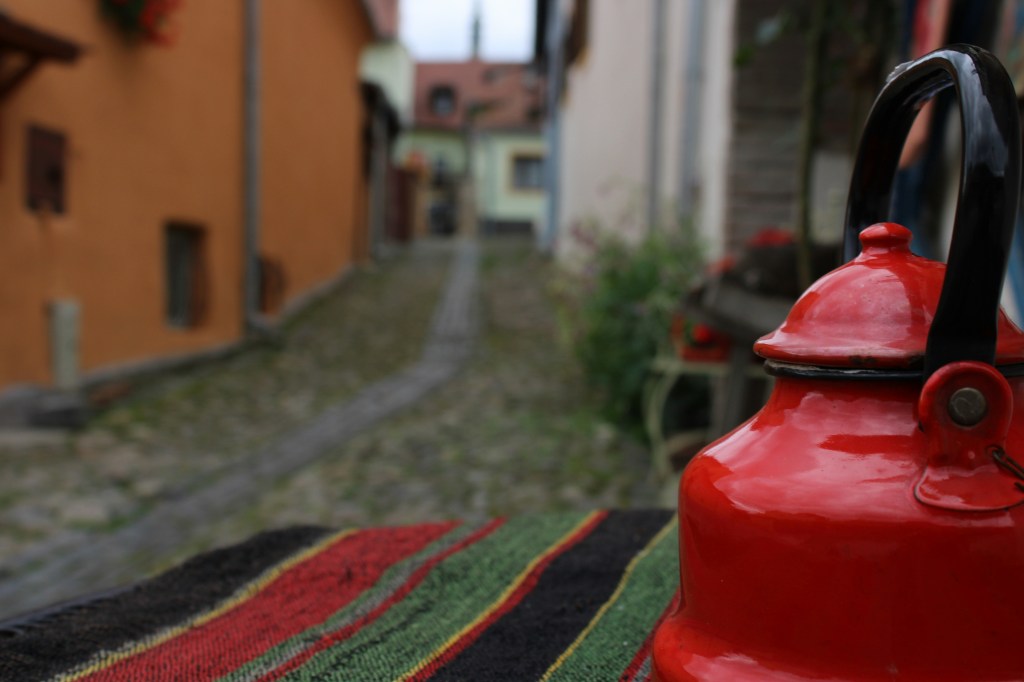
It was red. Boldly, unapologetically coral red. And it lived in a house where red was not welcome. Brown was fine. Grey was fine. Pale green was tolerated. But red? Absolutely not. Too loud, they said. Too strange. Too much. Yet the old teapot had once belonged to Grandma — a woman who didn’t judge things by colour. She loved objects for their memories. Each one carried a story, a moment, a heartbeat from long ago. And this teapot, though chipped in several places where the red paint had flaked away, still made the most wonderful tea — chamomile, mint, elderflower, even caraway. Whatever herbs went in, they came out tasting like comfort and warmth and quiet afternoons in Grandma’s kitchen. She kept it in her little pantry, on a shelf between the jars of jam and pickles.
The jars came and went each year, filled and emptied, replaced and renewed. Only the teapot stayed. But the older it got, the more out of place it felt among the new jars. “Things aren’t what they used to be,” the teapot would mutter to itself. “In the old days, jars understood things. We could talk about life… about hunger and winter and staying strong. But these modern jars? They just stare with their shiny new lids and say nothing. Maybe I’m the strange one now…” It talked less and less. Eventually it stopped trying to talk at all. The teapot grew silent, stiff, distant. Even the mice avoided it. Once, mouse mothers would gather their little ones around it at night to listen to stories. Now, the teapot’s cold stare frightened them away. One winter morning, something felt wrong. The pantry was bright with sunlight, long golden stripes stretching across the floor. But no footsteps came. No door creaked open. No gentle hand lifted the teapot from the shelf. Grandma did not come.
Not that day, nor the next, nor ever again. At first, the teapot waited patiently. Then anxiously. Then fearfully. Finally, trembling, it turned to the jars.
“Do… do any of you know what happened to Grandma?”
The jars shrugged in their glassy, indifferent way. They barely remembered her, except as the woman who sealed them shut every summer. They had no memories of her laughter or her cough when she was sick. No memories of her humming softly while she brewed tea.
They did not understand.
“But I was there when she raised her children,” whispered the teapot. “I held warmth for her when she was ill. I heard her stories, her laughter, her sadness. I stayed beside her for so many years… I need to know where she’s gone.”
The jars only clinked quietly among themselves, politely pretending to care while secretly rolling their eyes.
“Poor old thing,” they whispered behind its back. “Gone a bit odd with age.”
And so, winter passed. And spring.
And still no one came.
The little pantry slipped into silence so deep it felt like a forgotten attic of time.
Time passed quietly in the little pantry. Winter turned to spring, then faded into summer again — but no footsteps came down the hallway toward the wooden door. Dust began to gather on the shelves. The jars were replaced as always, but nobody came for tea.
One bright summer afternoon, the silence finally broke. The pantry door creaked open, and the old teapot’s worn handle tingled with hope — Grandma must have come for tea at last. But it was not Grandma. It was a young woman — one of her granddaughters, now grown — searching the shelves without familiarity, without warmth. Her eyes drifted over the jars, the tins, and finally landed nowhere at all.
She carried out a box filled with Grandma’s scarves, gloves, and faded photographs. Then she left. The door closed. Silence again.
Only this time, something cracked deep inside the old teapot. A restless tremor ran through its fragile body. It shifted — just a little — and then a little more. The shelf edge came too close.
And with a sudden clatter, the teapot fell — hitting the floor with a loud metallic gasp.
The lid rolled away in a crooked arc and disappeared beneath a shelf. For a moment, everything hurt — the metal ached with shock. But that crash had done something else: it had woken the sleeping box of old things.
Inside, the forgotten objects stirred.
A polished hairpin stretched languidly and sniffed disdainfully.
“What a miserable dusty place,” it muttered.
“Stop whining and mind your manners,” snapped a toothless wooden comb.
A cracked mirror rattled irritably.
“If someone tries to polish me again, I swear I’ll shatter myself out of spite.”
“Hush,” whispered Grandma’s old headscarf. “You’ll frighten the little ones.”
The objects froze for a moment, suddenly unsure — the little ones? Had someone else been here all along?
It was then that they saw the teapot — chipped, shaken, bent slightly from the fall, standing there in the sunlight that spilled from the small square window.
The teapot hesitated, gathering its courage, then spoke, voice trembling like steam on a cold morning:
“I… I’m waiting for Grandma. Do any of you know where she is?”
A pause.
Then the mirror, always too blunt, said flatly:
“She’s gone. She died. That’s what happens to people. They stop coming back.”
The teapot did not understand.
“What does that mean… died?”
“It means she’s not coming through that door ever again,” said the mirror. “End of story.”
“Don’t be cruel,” the scarf chided softly. “We all loved her.”
At that, something inside the old teapot caved in. Its bright coral-red surface seemed suddenly duller, faded by grief. The others watched as it trembled — not with restlessness now, but with sobbing, though a teapot cannot cry.
“I brewed her tea when she was sick,” it said weakly. “I heard her laugh. I heard her cry at night.
I warmed her hands on cold mornings. I… I don’t know what to do if she’s gone.”
The objects, even the grumbling comb and vain mirror, fell silent.
For a moment, all of them stood together in that dusty pantry with the stillness of deep, aching absence.
Then, very quietly, as if speaking to itself, the teapot whispered:
“I must find her.”
The pantry door opened again — not for Grandma, not even for comfort — but for clearance.
A pair of unfamiliar hands lifted box after box. The jars were packed away. Shelves were emptied. And when they came to the teapot, there was no hesitation. No last glance. No recognition.
“Finally getting rid of this old, ugly red thing,” someone muttered.
“She always kept the weirdest stuff…”
And just like that, the teapot was tossed — lidless, heart heavy — into a large box marked junk.
From there, the world became noisy, cold, and always moving.
There were bumpy rides, careless thuds, and at last — a hard landing on rough pavement. The box was dumped out like a pile of bones. And now the teapot lay at the top of a heap of discarded belongings in the street.
No shelf. No jars. No kitchen light.
No Grandma.
Days passed. The pavement was cold. People walked by. Some glanced, some wrinkled their noses, some kicked other objects aside. No one touched it with care.
By the third day, even grief began to feel heavy and numb.
Maybe I will rust here, thought the teapot. Maybe that is what happens when you no longer belong anywhere.
Then came the garbage truck.
With a loud growl and metal jaws, it began lifting heaps of trash. The teapot didn’t resist. It barely moved. Whether it was crushed, buried, or burned — it hardly mattered now.
But fate, or perhaps clumsiness, had other plans.
As a worker heaved the trash, the teapot was accidentally knocked loose. It rolled off the edge of the pile, clattering painfully, and tumbled into the narrow gap behind a lamppost — just out of sight.
The truck roared away.
Silence again.
Until a pair of slow, shuffling footsteps approached.
A weathered old man in a long-worn coat stopped beside the lamppost. His eyes were tired but kind. He bent down, squinting.
“Well now… look at you,” he murmured gently. “Pretty thing once, I bet. Left behind, huh?”
It was not a question he expected the teapot to answer.
He lifted it with surprising tenderness.
“You and I are not so different,” he whispered. “Thrown out when we stopped being useful.”
He tucked the teapot carefully into his frayed satchel.
“Come on then. It’s cold out here. You’ll come with me.”
That evening, under the shadow of a bridge where the old man slept, they made a small fire in a rusted can. He set the teapot beside him—not for tea, not yet, but almost as if it were a companion.
“Nobody calls me by any name these days,” he said softly, staring into the flames. “But once… someone did. Maybe I’ll tell you about her some night.”
He sighed, pulled his coat tighter, and patted the teapot.
“I’ll take care of you now. And maybe, on special days, we’ll make tea again.”
For the first time since Grandma’s shelf, the teapot did not feel entirely alone.
The seasons passed under the bridge.
Though the old man rarely brewed tea — it was a rare luxury — he spoke often to the teapot. In
quiet evenings by the small fire, he told stories of the life he once had: a kitchen with laughter, a wife who danced while stirring soup, a child who used to bring him wildflowers.
Sometimes, while he spoke, his rough fingers would lightly trace the teapot’s coral-red surface as though remembering what tenderness felt like.
“You know,” he said once, “she liked tea with honey… said it made sadness more polite.”
One icy winter morning, as they wandered the streets searching for warmth or kindness, the old
man collapsed. By the time help arrived, he was shaking violently. Paramedics lifted him onto a
stretcher. His satchel — with the teapot tucked inside — slipped from his shoulder and hit the ground with a dull thud.
“Sir — your bag?” a nurse asked gently.
But he was already unconscious, breathing in short gasps. They took him away.
The bag and the teapot stayed behind.
A hospital orderly found them, examined the contents, and sighed.
“Old junk. Can’t take this in.”
And so, the teapot found itself discarded again — this time on a cold pile of broken things in the hospital’s back lot.
No jars. No pantry. No old man by the fire.
It lay motionless.
This must be the end.
Grandma is gone. The old man is gone. I have been loved and abandoned twice.
But just as frost began to cling to its chipped handle, a different kind of chance arrived.
A man in a long dark coat moved quietly through the lot. An antique dealer — known for scouring forgotten corners for overlooked treasures.
He paused when he spotted the faint coral red beneath the frost. His eyes brightened.
“Well now… you’re rare,” he whispered, lifting it with careful hands. “A limited pattern. Mid-century. Hard to find in this condition…”
He brushed the dirt away, inspecting every curve with practiced admiration.
“I can fix you.”
He did.
Back in his little shop, he polished the metal, restored the chipped enamel, carefully fitted a replacement lid. In the lamplight, the teapot gleamed — brighter than it had in years, yet carrying a silent depth only something long-lived and well-travelled could hold.
He placed it on a high shelf in the front of the store — believing someone would eventually see what he saw.
But days passed. Then weeks. Then months.
People came and went — curious, polite, dismissive.
“Strange colour.”
“Too old-fashioned.”
“Smells a bit like herbs.”
The dealer eventually shifted it lower and lower on the shelves — until at last it rested on the bottom one, half-hidden among forgotten curiosities.
And there it stayed.
Quiet.
Waiting.
Not knowing for whom.
Until one afternoon, a young mother entered the shop with her three small sons.
“We’re looking for a teapot,” she said, “like the one my grandmother used to have. It was red — coral red. Sort of odd-shaped. And no matter what tea you brewed in it, the steam always smelled faintly of chamomile, or mint, or elderflower…”
The antique dealer paused. Slowly, he bent down to the lowest shelf.
When he placed the coral-red teapot on the counter, the woman gasped.
Her eyes softened with memory.
“This is it,” she whispered. “It’s exactly like hers.”
She lifted it gently, almost reverently, as though afraid it might disappear.
“My grandmother kept it even when the rest of the family hated the color. She said it made tea taste like… home.”
When she held it, something flickered awake inside the teapot — a warm, fragrant echo deep in
its metal heart:
Grandma humming.
Steam rising.
Laughter in the kitchen.
A little girl with brown eyes and shy dimples holding a cup with both hands.
Yes.
It remembered.
Tears welled in the woman’s eyes as she looked at the teapot.
“Welcome back,” she murmured softly — though she didn’t quite know why she said it that way.
She bought it at once — even when the dealer doubled the price, sensing sentiment was worth much more than enamel.
And so the teapot returned — not to the same house, but to the same lineage of love.
Back to chamomile and elderflower.
Back to children running through kitchens.
Back to someone who brewed tea not for guests, but for souls in need of warmth.
And sometimes, when late at night the house fell quiet and the young mother sipped tea alone at
the window, she found herself stroking the teapot’s coral-red curve gently without knowing why — the same way the old man once did, the same way Grandma had done.
And somewhere deep in its metal memory, the teapot no longer ached to belong.
Because it had come home — not to a place, but to a feeling.
***
The Old Teapot gently explores the themes of love, loss, belonging, and resilience through a symbolic journey that is easy for children to feel, even if they cannot yet fully analyse it.
• The teapot represents things — and people — who once felt loved and useful but later feared being forgotten or replaced.
• Children often face similar fears: What if no one needs me anymore? What if I am left behind or outgrown?
• The story shows that being discarded or overlooked doesn’t mean we are worthless — sometimes it simply means we haven’t yet reached the place where we are meant to belong again.
• It teaches that love doesn’t disappear when circumstances change — it can survive separation and return in unexpected ways.
• The teapot’s journey shows children that even after painful losses, they can find new forms of connection, safety, and meaning.
• It also emphasises loyalty and emotional memory: what was once treasured often remains quietly remembered and may return when the time is right.
• Finally, it reassures sensitive children that being “different” or “unfashionable” does not make someone unlovable. Sometimes, uniqueness is exactly what someone has been waiting for.
This story offers comfort to children (and adults) who fear abandonment or change — reminding them that even if life takes them far from where they once felt safe, they can still find warmth and home again.

