The Room Where You Now Live As a Memory
Something I have learned about story illustration while working towards the publication of one of my new children’s stories, The Little Boy Who Became a Memory, is this:
One can be an incredibly talented illustrator or artist, but reading a story emotionally is much harder to instruct, learn, or produce.
The Little Boy Who Became a Memory is a children’s story about a friendship between two little children that somehow ends without an ending. It ends with what we usually call ambiguous loss.
That’s the kind of loss that can be brutally hard to grieve, enormously difficult to integrate, and very hard to let go of. There is no proper ending to hold onto, and sometimes no clear place for the person who is no longer part of our life to go.
Recently, while looking for an illustrator for the story, I asked interested artists to choose a scene and create their own visual interpretation of it.
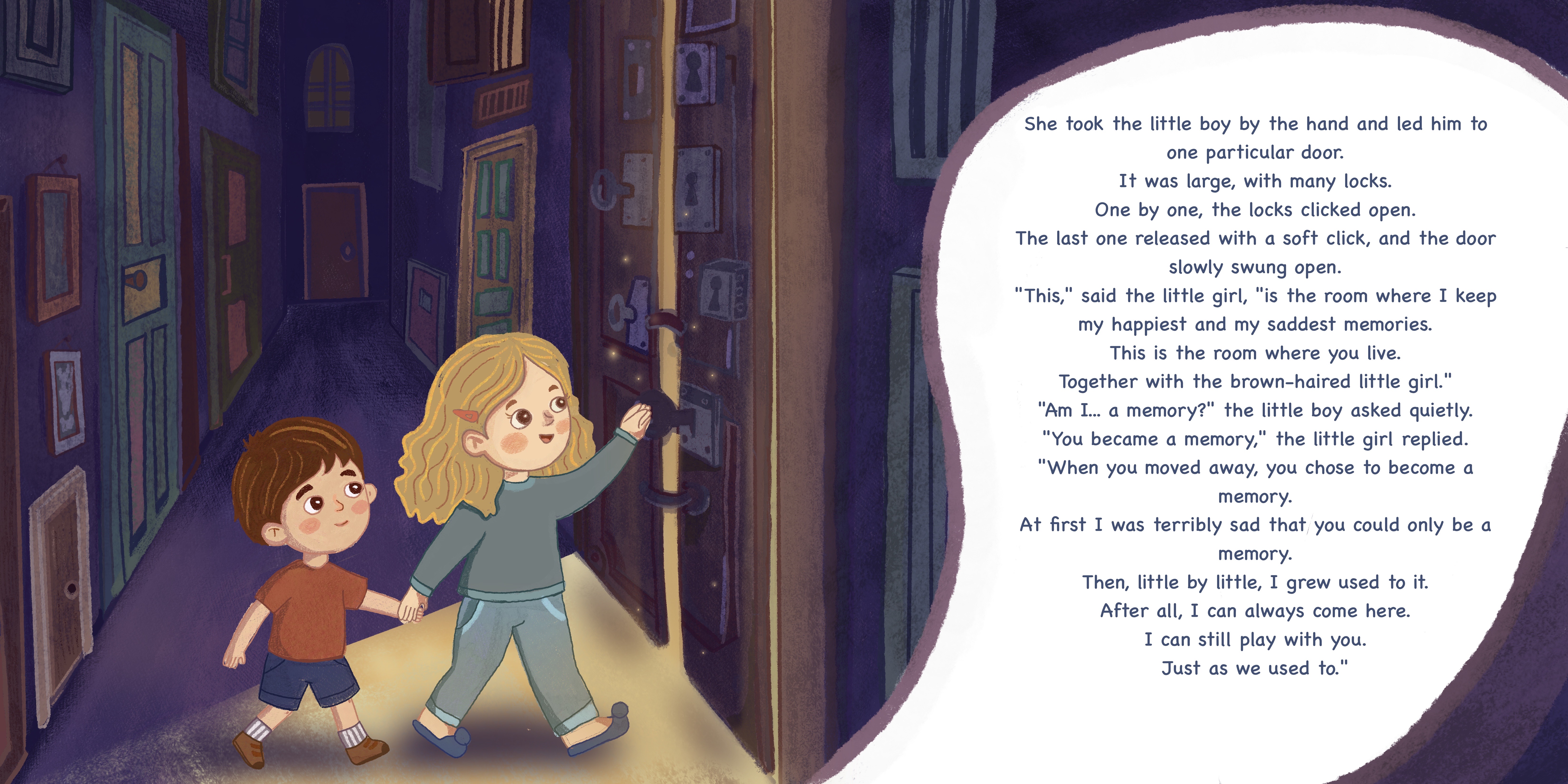
Bipuli Wanniarachchi sent me this concept illustration.
Stylistically, it was quite different from what I had imagined for this particular story. And yet, when I looked at it, it had an effect on me that I found surprisingly difficult to put into words.
Part of it was probably simply seeing a scene from something that had existed in my own internal world suddenly come to life through another person’s imagination.
But there was something else too: she read the story well.
Of all the scenes she could have chosen, Bipuli chose the one I consider the emotional centre of the story: the little girl takes the little boy by the hand, leads him down a corridor full of doors, and shows him the heavily locked room where he now lives, as a memory.
It is, in my view, a painfully sad scene.
But I think it is also full of integration and hope for healing.
It is the point at which the pain has finally subsided just enough for something else to become possible: the person who can no longer be part of our present slowly, painfully, and often imperfectly becomes part of our autobiographical memory.
They are no longer where we wanted them to be. They haven’t disappeared either.
They become part of the story of who we are.
What makes this particularly meaningful to me is that Bipuli had only the story itself. I hadn’t explained what sat behind it or told her which parts carried the most weight for me. I simply asked her to choose a scene.
And she chose this one.
I think that is something quite special an illustrator can bring to a writer. You create something from your own internal world and give it to another person. They read it, take it into theirs, and then give a piece of it back to you in a form you have never seen before.
And suddenly, something that had only existed inside you has an image.

